Why Your 3PL Fulfillment Center Location Matters More Than You Think
In today’s fast-paced business environment, where next-day and same-day delivery options have become the norm, the strategic placement of your 3PL fulfillment center can make or break your customer experience. But how do you determine the ideal location for your warehousing and distribution operations?
At MacMillan Supply Chain Group, we’ve helped countless businesses optimize their fulfillment networks across Canada and beyond. We’ve learned that successful 3PL fulfillment center selection isn’t just about finding available space—it’s about making a strategic decision that balances multiple factors to create a competitive advantage.
Whether you’re looking for fulfillment services in Canada or exploring cross-border shipping options, understanding these five key evaluation factors will help you make informed decisions that drive efficiency, reduce costs, and ultimately delight your customers.
Geographic Proximity to Your Customer Base
The most fundamental factor in selecting a 3PL fulfillment center location is proximity to your customers. Why? Because being closer to your end consumers directly translates to faster delivery times and reduced shipping costs.
Canadian businesses often face unique challenges due to the country’s vast geography and dispersed population centers. If most of your customers are concentrated in Ontario, a fulfillment center in Toronto makes perfect sense. Similarly, if you serve Western Canada, a fulfillment center in Vancouver provides strategic advantages.
When analyzing customer proximity, consider these elements:
- Customer density maps: Where are your customers most concentrated? High-density areas often justify dedicated fulfillment centers.
- Shipping zones: Carriers like Canada Post and FedEx use zone-based pricing. The fewer zones a package crosses, the lower your shipping costs.
- Delivery time expectations: If you promise two-day delivery, your fulfillment center must be positioned to meet that commitment.
For businesses serving both Canadian and U.S. markets, cross-border shipping considerations become crucial. A strategically located warehouse near major border crossings can significantly reduce customs delays and transportation costs.
Remember, the goal isn’t necessarily to be close to your business headquarters—it’s to be close to your customers. Many successful e-commerce companies operate fulfillment centers hundreds of kilometers from their main offices to optimize their distribution networks.
Transportation Infrastructure and Accessibility
Even the most perfectly positioned 3PL fulfillment center won’t deliver value if it lacks proper transportation connections. When evaluating potential locations, transportation infrastructure should be a top priority.
Look for these key transportation elements:
The quality of local roads and seasonal considerations also matter. Some regions experience severe winter conditions that can impact delivery reliability. A fulfillment center in Toronto or Vancouver typically offers more consistent year-round accessibility than more remote locations.
For businesses engaged in cross-border logistics fulfillment, proximity to major border crossings like Windsor-Detroit, Niagara Falls, or Vancouver-Seattle corridors can streamline customs processes and reduce transit times.
Don’t overlook last-mile delivery solutions in CA either. Urban fulfillment centers may face traffic congestion but offer faster final delivery, while suburban locations might provide better highway access but longer last-mile routes.
Technology Integration and Warehouse Management Systems
Modern 3PL fulfillment centers are technology-driven operations. When selecting a location, the technological capabilities of the facility should factor heavily into your decision-making process.
Leading Canadian 3PL solutions providers offer advanced warehouse management systems (WMS) that provide:
- Real-time inventory visibility
- Order tracking capabilities
- Integration with your e-commerce platforms
- Automated picking and packing processes
- Detailed reporting and analytics
The technology infrastructure at your chosen location directly impacts fulfillment accuracy, processing speed, and overall operational efficiency. A technologically advanced fulfillment center in Vancouver or Toronto might command higher rates but deliver superior performance that justifies the investment.
When evaluating technology capabilities, ask potential 3PL partners:
- How does their WMS integrate with your existing systems?
- What level of visibility will you have into inventory and orders?
- What automation technologies are deployed in the facility?
- How do they handle system upgrades and maintenance?
- What redundancies exist to prevent downtime?
For e-commerce fulfillment in CA, seamless integration between your online store and the 3PL’s systems is particularly crucial. The right technology stack enables real-time inventory updates, automated order processing, and efficient returns management—all essential components of a positive customer experience.
Remember that technology capabilities can vary significantly between facilities, even within the same 3PL network.
Cost Structure and Economic Considerations
While strategic location and technological capabilities are crucial, cost remains a fundamental consideration when selecting a 3PL fulfillment center. Understanding the complete cost structure helps you make economically sound decisions.
When evaluating affordable fulfillment centers in Canada, consider these cost factors:
- Base storage costs: How much will you pay per square foot or pallet position?
- Order processing fees: What are the picking, packing, and shipping charges?
- Value-added service costs: Are there additional fees for kitting, custom packaging, or returns processing?
- Minimum commitments: Is there a monthly minimum charge regardless of volume?
- Seasonal surcharges: Do rates increase during peak periods?
Regional economic variations can significantly impact your total costs. While warehouse space in downtown Toronto commands premium rates, facilities in surrounding areas may offer substantial savings while maintaining excellent transportation access.
Labor costs also vary by region. Areas with competitive job markets may have higher wage requirements but often provide access to a more skilled workforce. This is particularly important for fulfillment operations requiring specialized handling or technical expertise.
For businesses utilizing cross-border shipping from Canada, understanding the complete landed cost picture—including duties, taxes, and customs brokerage fees—is essential for accurate financial planning.
Don’t focus exclusively on the lowest base rate. A slightly higher-priced facility with superior efficiency, lower error rates, and better transportation options often delivers better overall value and lower total fulfillment costs.
Challenges in 3PL Fulfillment Center Location Selection
Despite its importance, many businesses struggle with fulfillment center location selection. Here are the most common pitfalls:
Focusing Solely on Real Estate Costs
Many companies make the mistake of choosing locations based primarily on warehouse lease rates, overlooking the fact that transportation often represents 50-70% of total logistics costs. A cheaper warehouse in a suboptimal location can dramatically increase overall expenses.
Underestimating Seasonal Fluctuations
Businesses frequently select facilities that meet their average needs but can’t accommodate peak volumes. This leads to service failures during crucial high-volume periods like holiday seasons.
Neglecting Future Growth
Choosing a location that meets current needs without considering scalability can force relocations or network redesigns as your business grows, creating unnecessary disruption and expense.
Poor Integration Planning
Many companies discover too late that their chosen 3PL’s technology systems don’t integrate well with their own platforms, creating visibility gaps and operational inefficiencies.
Overlooking Regulatory Requirements
Different provinces have varying regulations affecting warehousing and distribution. Failing to consider these regulatory differences can create compliance issues and unexpected costs.
Inadequate Transportation Analysis
Businesses often conduct insufficient analysis of transportation options and costs, leading to higher-than-expected shipping expenses and delivery delays.
Neglecting Returns Processing
Many location decisions focus exclusively on outbound shipments without adequately considering reverse logistics requirements, creating inefficient returns processes.
MacMillan’s Approach to Optimal 3PL Fulfillment Center Selection
At MacMillan Supply C
hain Group, we’ve developed a comprehensive methodology for fulfillment center location selection that addresses these common challenges and delivers superior results for our clients.
Data-Driven Geographic Analysis
We begin with sophisticated data analysis to map your customer concentrations and order patterns. This allows us to identify optimal locations that minimize total transportation costs while meeting delivery time requirements. Our analysis includes:
- Historical order data evaluation
- Customer density mapping
- Delivery time modeling
- Shipping cost optimization across Canadian shipping zones
- Seasonal variation analysis
For businesses requiring e-commerce fulfillment in CA, we pay particular attention to urban delivery capabilities and last-mile delivery solutions. Our network of fulfillment centers in Toronto, Vancouver, and other strategic locations ensures we can position your inventory optimally relative to your customer base.
Comprehensive Transportation Network Assessment
Our team conducts thorough transportation infrastructure evaluations for potential locations, considering:
- Carrier availability and service levels
- Highway access and traffic patterns
- Intermodal connections
- Cross-border shipping capabilities
- Delivery time performance
For clients requiring warehousing in Ontario, we leverage our extensive knowledge of the region’s transportation networks to identify locations offering the optimal balance of accessibility and cost-effectiveness.
Advanced Technology Integration
MacMillan’s fulfillment centers feature state-of-the-art warehouse management systems that seamlessly integrate with your business platforms. Our technology solutions provide:
- Real-time inventory visibility
- Automated order processing
- Detailed performance analytics
- Mobile access to critical information
- EDI and API integration capabilities
We understand that technology integration is not a one-size-fits-all proposition. Our IT specialists work closely with your team to ensure smooth data flow between systems, eliminating the integration headaches common with less experienced providers.
Transparent, Comprehensive Cost Modeling
We believe in complete transparency when it comes to fulfillment costs. Our detailed cost modeling includes:
- All handling and storage charges
- Complete transportation cost analysis
- Value-added service pricing
- Volume-based discount structures
- Seasonal considerations
This comprehensive approach eliminates surprises and allows for accurate financial planning.
Scalable Solutions for Growth
MacMillan’s network of fulfillment centers across Canada is designed with scalability in mind. Our facilities feature:
- Flexible space configurations
- Modular capacity expansion options
- Seasonal staffing capabilities
- Technology platforms that scale with your business
Whether you’re experiencing steady growth or dramatic seasonal fluctuations, our 3PL network expansion capabilities ensure we can accommodate your changing needs without service disruptions.
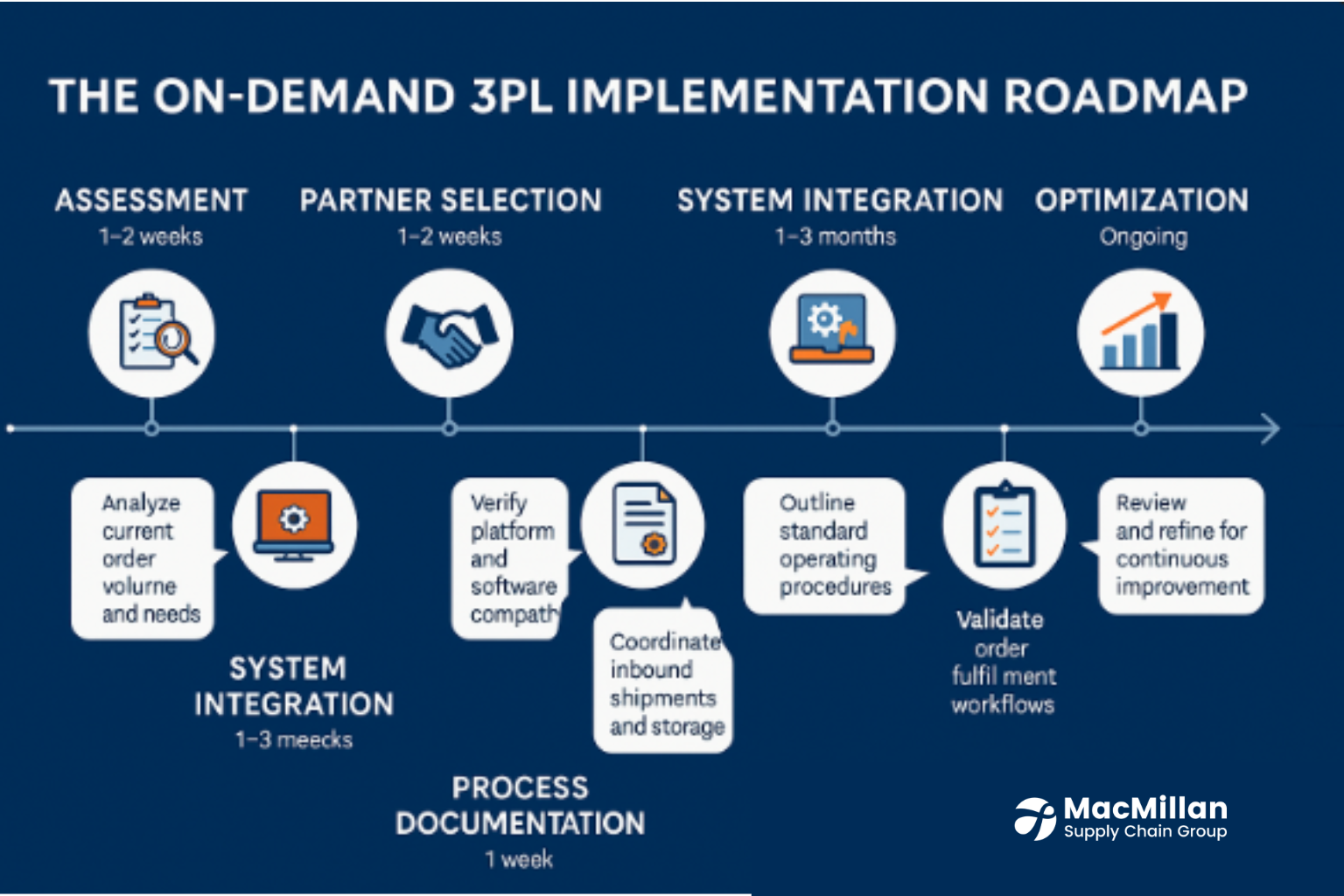
Implementing Your Optimal 3PL Fulfillment Strategy
Ready to optimize your fulfillment center location strategy? Here’s how to get started:
Step 1: Analyze Your Current Distribution Patterns
Begin by mapping where your customers are located and how your current fulfillment network serves them. Identify gaps in coverage and areas where shipping costs or delivery times could be improved.
Step 2: Define Your Service Requirements
Clearly articulate your delivery time promises, special handling needs, and technology integration requirements. These specifications will guide your evaluation of potential 3PL partners.
Step 3: Evaluate Multiple Location Options
Don’t limit yourself to a single location. Consider how a network of fulfillment centers might better serve your customers than a centralized approach. For many businesses, a combination of fulfillment centers in Toronto, Vancouver, and other strategic locations provides optimal coverage.
Step 4: Request Detailed Proposals
When approaching third-party logistics providers in Canada, request comprehensive proposals that address all aspects of your fulfillment needs, including technology capabilities, transportation options, and scalability provisions.
Step 5: Partner with MacMillan Supply Chain Group
Let our experts guide you through the complex process of fulfillment center selection. With our extensive network of strategically located facilities and decades of experience in Canadian 3PL solutions, we can design and implement a fulfillment strategy that optimizes your supply chain performance.
Contact MacMillan Supply Chain Group today to discuss how our fulfillment services in Canada can help you reduce costs, improve delivery times, and enhance customer satisfaction.