Optimizing E-commerce Warehouse Costs to Boost Your Profit Margins

In this article:

MacMillan Supply Chain Group Elevate Your Logistics Experience

Subscribe for more articles like this!

Subscription Form

A Quick Summary and Overview

E-commerce warehouse operations typically consume 50-55% of total operating costs, making optimization crucial for profitability. By implementing strategic improvements in layout, technology, inventory management, and labor allocation, businesses can reduce costs by up to 75% per order while improving accuracy from 85% to 99.8%. This article explores practical strategies for optimizing warehouse costs, from layout redesign to automation, and explains how partnering with MacMillan Supply Chain Group can transform your e-commerce operations and boost profit margins.

Introduction

Is your e-commerce business struggling with rising warehouse costs eating into your profit margins? You’re not alone. In today’s competitive online retail landscape, the efficiency of your fulfillment operations can make or break your business success. Warehouse operations typically consume more than half of an e-commerce company’s operating budget, presenting both a challenge and an opportunity.

The good news? Even modest improvements in warehouse efficiency can dramatically impact your bottom line. From smarter layouts to cutting-edge automation, from inventory optimization to strategic 3PL partnerships, there are multiple paths to reducing costs while improving service levels.

In this comprehensive guide, we’ll explore proven strategies for optimizing e-commerce warehouse costs and transforming your fulfillment operations. Whether you’re running a small Canadian online store or managing a large cross-border e-commerce operation, these insights will help you identify opportunities to boost your profit margins while delivering exceptional customer experiences.
Understanding Warehouse Cost Structures

Before diving into optimization strategies, it’s essential to understand where your warehouse dollars are going. For most e-commerce operations, costs break down into several key categories that offer different optimization opportunities.

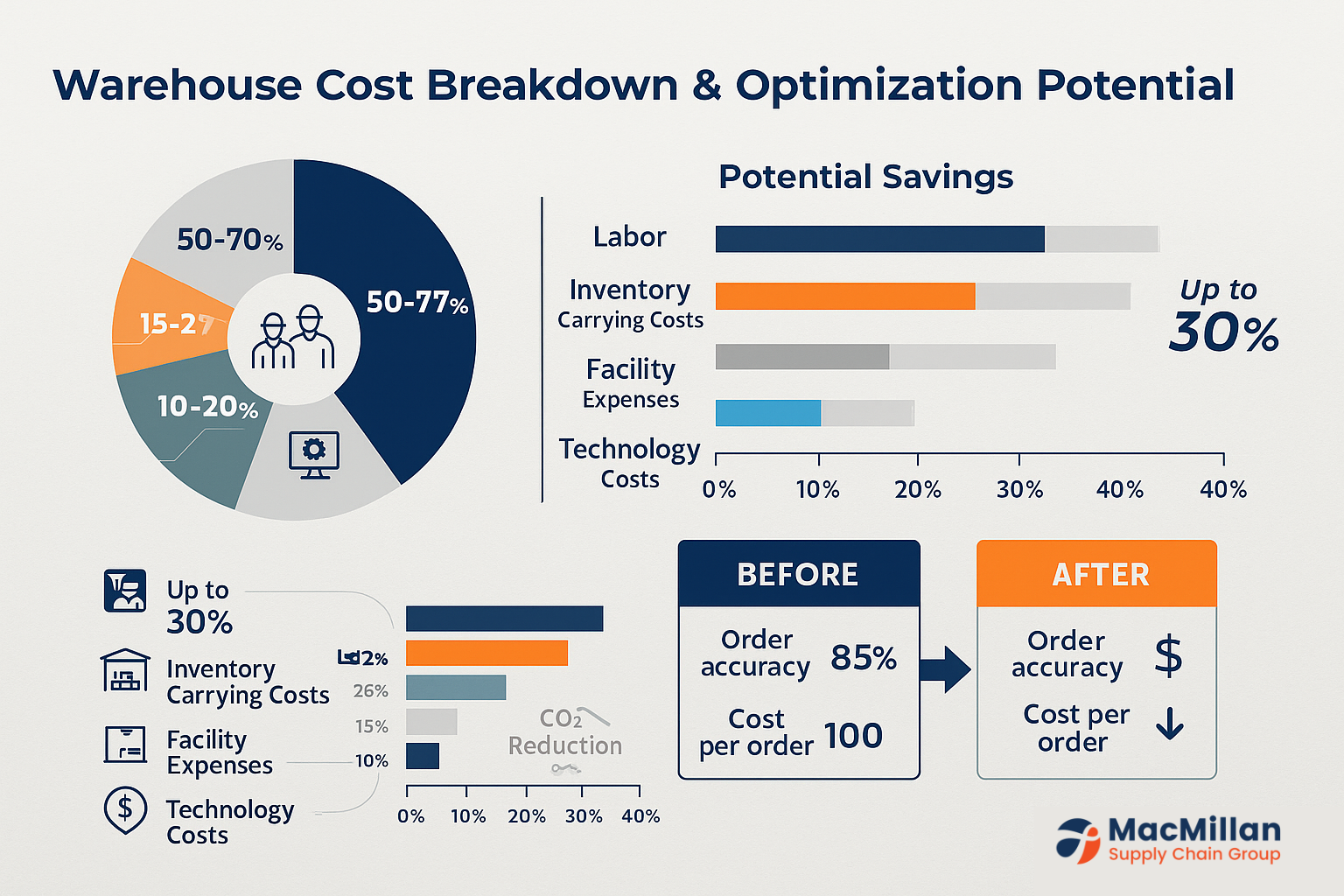
Labor typically represents the largest expense, accounting for 50-70% of warehouse operating costs. This includes not just wages but also training, benefits, overtime, and management overhead. As warehouse wages continue rising (nearly four times the national average in recent years), labor optimization becomes increasingly critical.

Space utilization presents another significant cost factor. Whether you’re leasing or owning your facility, every square foot carries a price tag. Many warehouses operate at just 60-70% space efficiency, leaving substantial room for improvement through better layout planning and storage solutions.

Inventory carrying costs silently drain profits, consuming 15-27% of inventory value annually through warehouse fees, insurance, depreciation, and spoilage. These costs multiply for businesses operating multiple locations without unified inventory management systems, as each facility maintains excess safety stock.

Technology infrastructure represents both a cost and an investment. While implementing advanced warehouse management systems requires upfront investment, the ROI typically materializes quickly through improved accuracy, efficiency, and reduced labor requirements.

Equipment maintenance, utilities, packaging materials, and shipping costs round out the expense picture. By analyzing your specific cost breakdown, you can prioritize optimization efforts where they’ll deliver the greatest impact on your profit margins.
Strategic Warehouse Layout Planning

Your warehouse layout fundamentally determines operational efficiency and cost structure. Even without significant technology investments, thoughtful layout redesign can deliver substantial savings and productivity improvements.

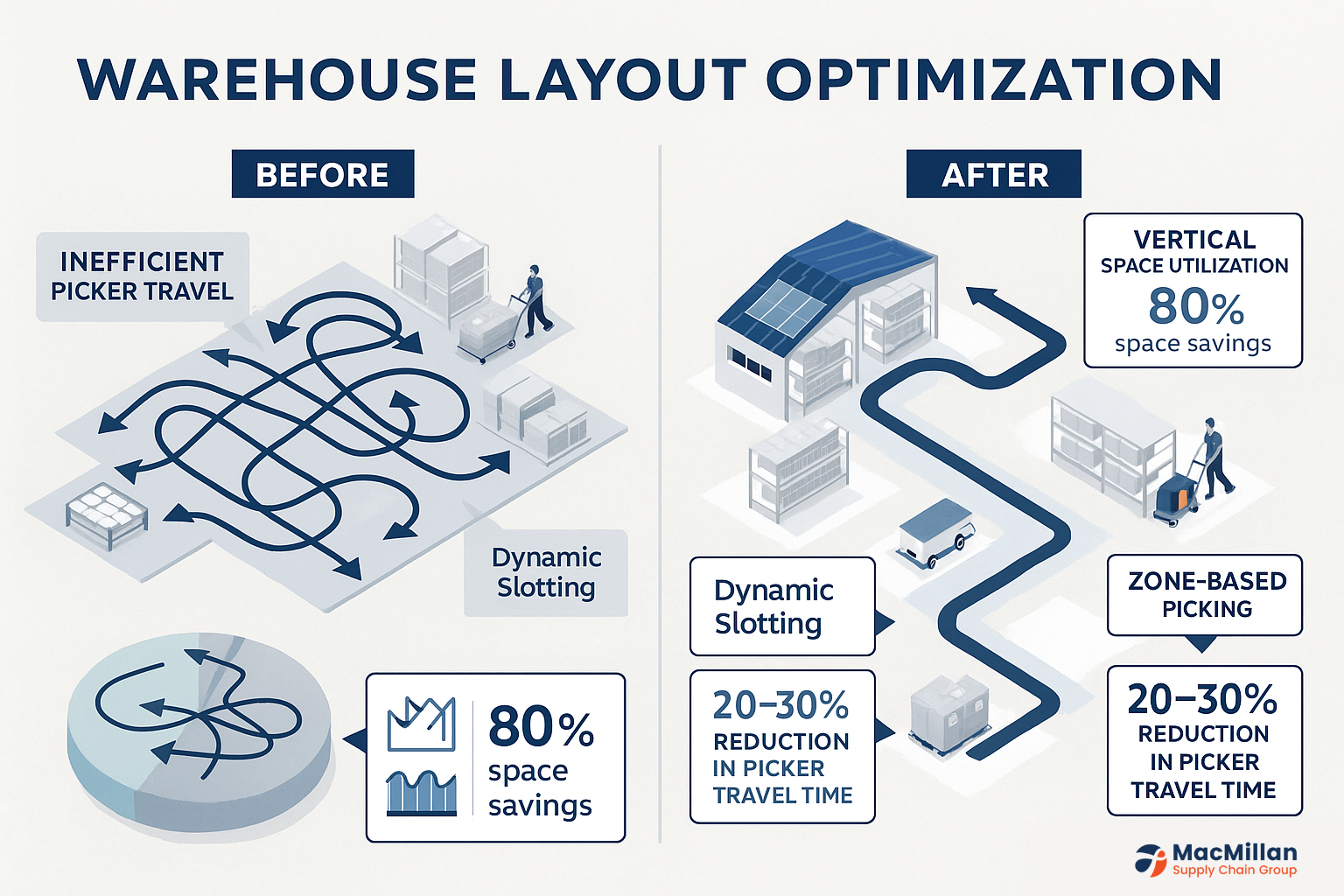
The most effective layouts follow U-shaped or straight-through flow patterns that minimize cross-traffic and eliminate bottlenecks in high-volume processing areas. This simple principle can reduce picker travel time by 20-30%, directly impacting labor costs and order fulfillment speed.

Vertical space utilization offers another high-impact opportunity. Many warehouses fail to maximize their cubic footage, focusing only on floor space. Advanced storage systems can quadruple capacity within the same footprint through taller, denser shelving configurations and mezzanine installations. Modern automated storage and retrieval systems achieve up to 80% floor space savings while improving picking accuracy and speed.

Dynamic slotting strategies represent sophisticated inventory positioning that adapts to changing demand patterns. Fast-moving SKUs positioned closer to packing stations reduce picker travel time, while seasonal demand patterns trigger automatic inventory repositioning. This approach ensures your most popular items are always in the most accessible locations.

Zone-based picking systems divide warehouse space into specialized areas with dedicated staff, reducing congestion and improving workflow efficiency. Each zone operates semi-independently, allowing parallel processing of multiple orders while maintaining quality control through specialized expertise.

Cross-docking integration creates additional space optimization opportunities by eliminating storage time for fast-moving items that transfer directly from inbound to outbound vehicles. This strategy particularly benefits businesses with predictable demand patterns and reliable supplier relationships.

By implementing these layout optimization principles, you can achieve significant cost savings without major capital investments, creating a solid foundation for more advanced optimization initiatives.
Technology Integration and Automation

Technology has transformed warehouse operations, offering powerful tools for cost reduction and efficiency improvement. From basic inventory management software to advanced robotics, technology investments typically deliver compelling ROI for e-commerce operations.

Warehouse Management Systems (WMS) serve as the central nervous system for optimized fulfillment operations. The transformation from manual tracking to comprehensive WMS platforms typically delivers order accuracy improvements from 85% to 99.8% while reducing labor costs through intelligent task assignment and route optimization. Modern systems process real-time data from multiple sources to orchestrate complex fulfillment operations with precision exceeding human capabilities.

Automation solutions range from simple conveyor systems to sophisticated robotics. Autonomous mobile robots (AMRs) now handle everything from picking to packing, reducing labor requirements while improving accuracy and throughput. The warehouse robotics market reached $6.1 billion in 2023 and is projected to hit $10.5 billion by 2028, reflecting widespread adoption of these productivity-enhancing technologies.

Barcode and RFID systems eliminate manual data entry and tracking errors, providing real-time visibility into inventory movements. These technologies reduce labor costs while dramatically improving inventory accuracy, reducing costly stockouts and overstock situations.

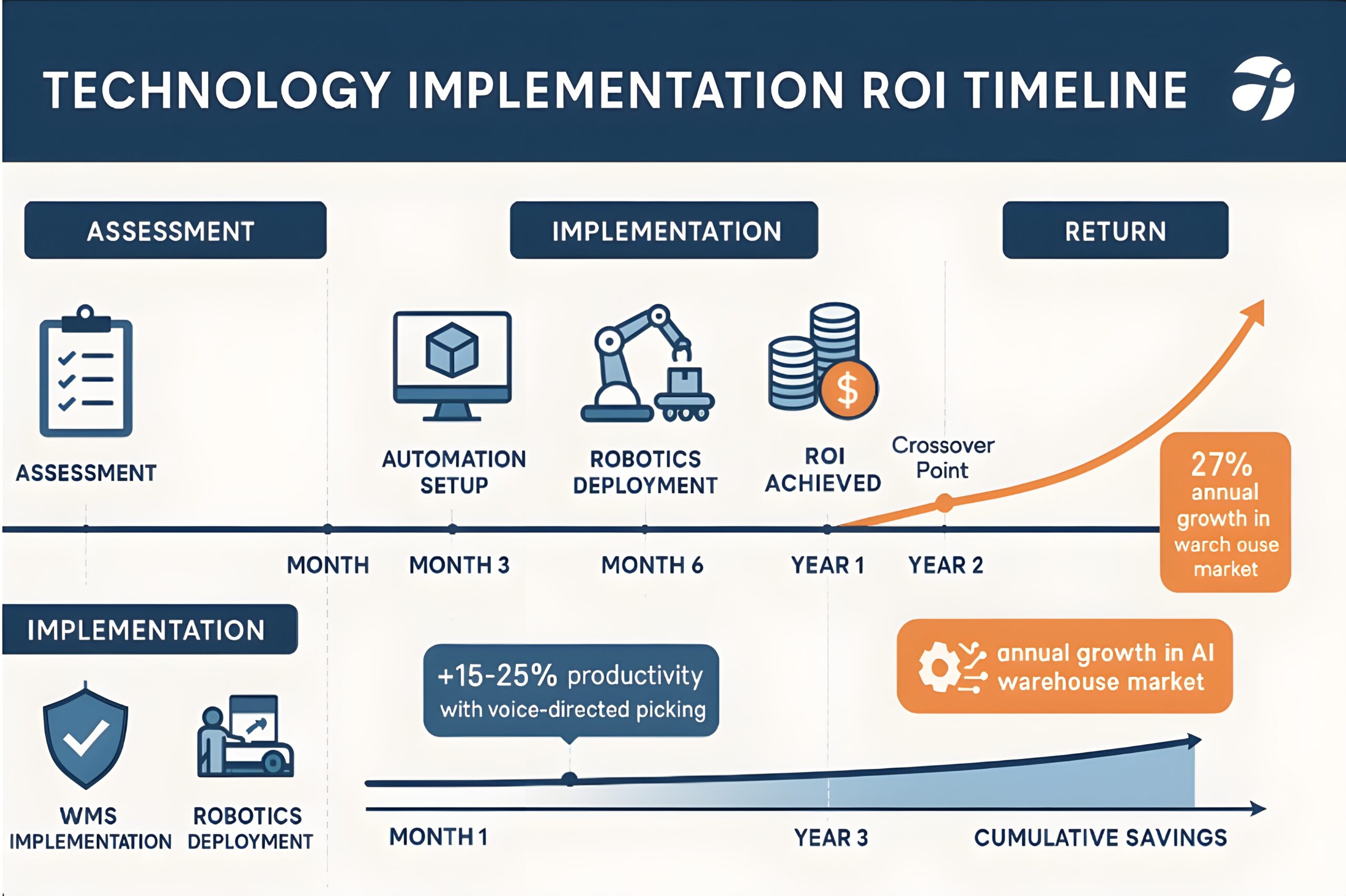
Voice-directed picking systems free workers’ hands and eyes, improving both speed and accuracy. These systems typically boost productivity by 15-25% while reducing training time for new employees, addressing both cost and labor availability challenges.

Artificial intelligence and machine learning capabilities provide predictive analytics that anticipate operational challenges before they impact performance. AI-driven demand forecasting analyzes historical data, seasonal patterns, and external factors to optimize inventory positioning and reduce carrying costs. The software-driven segment of the AI warehouse market expands at a 27% annual rate and is projected to reach $31.5 billion by 2032.

When implementing technology solutions, focus on integration capabilities. Modern platforms offer pre-built connections to major ERP systems, transportation management platforms, e-commerce marketplaces, and shipping carriers. These integrations eliminate data silos that hinder operational efficiency while ensuring financial data flows seamlessly between warehouse operations and accounting systems.


Inventory Management Excellence

Inventory represents both a significant asset and a major cost center for e-commerce businesses. Strategic inventory management directly impacts warehouse costs through space utilization, labor requirements, and carrying costs.

Just-in-time inventory approaches minimize storage costs by ordering goods only as needed, reducing overstocking risk while lowering warehouse expenses and improving cash flow. This approach requires strong supplier relationships and accurate demand forecasting but enhances efficiency, shortens production cycles, and frees up capital tied in excess inventory.

Advanced inventory management systems provide real-time visibility into stock levels, demand patterns, and reorder points, enabling businesses to maintain optimal inventory levels without traditional safety stock requirements. Modern platforms maintain accuracy rates over 99%, dramatically reducing costly errors from manual inventory control methods.

Demand forecasting accuracy emerges as critical for inventory optimization. Advanced analytics tools analyze trends and external factors including seasonality, promotional impacts, and market conditions to optimize purchasing decisions. Smart forecasting systems factor in supplier lead times and seasonal variations, making reordering decisions more intelligent and ensuring popular items remain stocked during high-demand periods.

ABC inventory classification prioritizes management attention and resources based on item value and movement frequency. “A” items (high-value, high-velocity) receive the most rigorous controls and prime warehouse locations, while “C” items (low-value, low-velocity) can be managed with simpler approaches and stored in less accessible areas.

Cycle counting replaces disruptive annual inventory counts with ongoing verification processes that maintain accuracy without operational shutdowns. This approach identifies discrepancies earlier while distributing counting workload more evenly throughout the year.

Batch and lot tracking capabilities ensure product traceability and enable efficient recall management when necessary. These systems also support FIFO (first-in, first-out) inventory management, reducing spoilage and obsolescence costs for perishable or fashion-sensitive merchandise.

By implementing these inventory management best practices, you can simultaneously reduce warehouse space requirements, labor costs, and carrying costs while improving customer satisfaction through better product availability.

Common Problems with Warehouse Cost Management

Despite best intentions, many e-commerce businesses struggle with warehouse cost optimization. Understanding these common pitfalls can help you avoid them in your operations.

Siloed systems and data create visibility gaps that lead to inefficient decision-making. When your inventory management, order processing, and shipping systems don’t communicate effectively, you end up with duplicate efforts, reconciliation challenges, and missed optimization opportunities.

Reactive rather than proactive management approaches result in firefighting rather than strategic improvement. Many warehouse managers spend their days solving immediate problems rather than addressing root causes and implementing systematic improvements.

Underinvestment in training leads to higher error rates, slower processing times, and increased safety incidents. Warehouse staff need ongoing skill development to maintain productivity and adapt to changing requirements.

Ineffective performance measurement makes it impossible to identify improvement opportunities or track progress. Without clear metrics and regular analysis, warehouse operations drift toward inefficiency rather than continuous improvement.

Suboptimal carrier selection and shipping practices inflate transportation costs unnecessarily. Many businesses default to familiar carriers rather than strategically selecting the most cost-effective option for each shipment based on weight, dimensions, destination, and delivery timeframe.

Seasonal volume fluctuations create staffing and space challenges that impact costs and service levels. Without flexible capacity strategies, businesses either maintain excess resources year-round or struggle with peak period fulfillment.

Manual processes persist even when automation would deliver clear benefits. Paper-based picking, manual inventory counts, and other traditional approaches consume labor hours that could be eliminated through technology adoption.

Poor inventory forecasting leads to either stockouts (lost sales and emergency replenishment costs) or overstocking (excess carrying costs and potential obsolescence). Many businesses rely on simplistic forecasting methods that fail to account for seasonality, trends, and market dynamics.

Recognizing these common problems is the first step toward addressing them through strategic warehouse cost optimization initiatives.

Our Solutions: MacMillan’s Approach to Warehouse Cost Optimization

At MacMillan Supply Chain Group, we’ve developed a comprehensive approach to warehouse cost optimization that delivers measurable results for our e-commerce clients. Our methodology combines strategic analysis, technology integration, operational excellence, and continuous improvement to transform fulfillment operations.

We begin with a thorough assessment of your current operations, identifying specific cost drivers and improvement opportunities. Our experienced consultants analyze your order profiles, inventory characteristics, facility layout, technology infrastructure, and workforce utilization to develop a customized optimization roadmap.

Our warehouse layout optimization services redesign your physical space to maximize efficiency and throughput. We apply proven principles including product velocity analysis, travel path optimization, and vertical space utilization to create layouts that minimize movement while maximizing accessibility. These redesigns typically reduce picker travel by 20-30% while increasing storage capacity by 15-40%.

Technology integration forms the backbone of our optimization approach. We implement and configure advanced warehouse management systems that orchestrate operations with precision while providing real-time visibility and control. Our technology solutions integrate seamlessly with your existing e-commerce platforms, creating unified information flows that eliminate data silos and manual reconciliation.

Automation deployment follows a pragmatic, ROI-focused approach. Rather than pursuing technology for its own sake, we identify specific processes where automation delivers clear benefits in cost reduction, accuracy improvement, or scalability. Our solutions range from simple conveyor systems to sophisticated robotics, always tailored to your specific requirements and budget constraints.

Inventory optimization combines advanced forecasting, strategic positioning, and cycle counting to reduce carrying costs while improving availability. Our demand forecasting models incorporate multiple variables including seasonality, promotional impacts, and market trends to optimize purchasing and replenishment decisions. We implement ABC classification and dynamic slotting to ensure your most important products receive appropriate attention and optimal warehouse positioning.

Labor optimization balances productivity, quality, and employee engagement. We develop standardized processes, implement performance metrics, and create incentive systems that align worker interests with operational goals. Our ergonomic workstation designs and safety programs reduce injuries and absenteeism while improving productivity and retention.

Transportation cost management leverages our carrier relationships and volume aggregation to secure preferential rates for our clients. We optimize packaging to minimize dimensional weight charges, consolidate shipments where appropriate, and select the most cost-effective carrier for each delivery based on comprehensive analysis rather than habit.

For clients seeking comprehensive solutions, our third-party logistics services provide complete fulfillment operations management. By outsourcing to MacMillan, you gain access to our established facilities, trained workforce, advanced technology, and logistics expertise without capital investment or management overhead. Our multi-location network enables strategic inventory positioning that reduces transportation costs while accelerating delivery to your customers.

Throughout all engagements, we maintain rigorous performance measurement and continuous improvement processes. Regular analysis identifies emerging opportunities and ensures optimization initiatives deliver expected results. This disciplined approach ensures your warehouse operations become progressively more efficient and cost-effective over time.

The results speak for themselves: our clients typically achieve 15-30% cost reductions while simultaneously improving service levels, accuracy, and scalability. Whether you’re struggling with specific warehouse challenges or seeking comprehensive fulfillment transformation, MacMillan Supply Chain Group delivers solutions that boost your profit margins while enhancing customer satisfaction.

Implementation Strategy: Your Path to Optimized Warehouse Costs

Transforming your warehouse operations doesn’t happen overnight, but with the right approach, you can begin seeing results quickly while building toward comprehensive optimization. Here’s how to get started on your warehouse cost optimization journey.

Begin with data collection and analysis to establish your baseline and identify your biggest opportunities. Gather information on current costs, processing times, error rates, space utilization, and other key metrics. This baseline provides both a starting point for improvement measurement and insights into where to focus initial efforts.

Prioritize improvements based on implementation effort and financial impact. Look for “quick wins” that deliver meaningful benefits with minimal investment or disruption. These early successes build momentum and can often fund more substantial initiatives.

Develop a phased implementation plan that balances immediate improvements with longer-term transformation. Your roadmap should include specific initiatives, resource requirements, timeline expectations, and anticipated benefits. This structured approach prevents overwhelming your team while ensuring steady progress.

Invest in change management and training to ensure successful adoption. Even the best optimization strategies fail without proper implementation and user acceptance. Communicate the reasons for changes, provide comprehensive training, and address concerns proactively to maintain operational continuity during transitions.

Consider partnering with MacMillan Supply Chain Group to accelerate your optimization journey. Our expertise and resources can dramatically reduce implementation time and risk while maximizing results. Whether you need targeted consulting or comprehensive fulfillment services, we tailor our solutions to your specific needs and objectives.

Our partnership options include:

  • Consulting services that provide expert analysis and recommendations
  • Technology implementation and integration support
  • Partial fulfillment services that complement your internal operations
  • Complete 3PL solutions that handle all aspects of warehousing and fulfillment

By working with MacMillan, you gain access to proven methodologies, advanced technologies, and specialized expertise without developing these capabilities internally. Our experience across diverse e-commerce categories ensures we understand your specific challenges and opportunities.

Ready to start optimizing your warehouse costs and boosting your profit margins? Contact MacMillan Supply Chain Group today for a complimentary consultation. Our experts will analyze your current operations, identify specific improvement opportunities, and recommend a customized approach to warehouse cost optimization that delivers measurable results for your business.

Don’t let warehouse inefficiencies continue draining your profits. Take the first step toward optimization by reaching out to MacMillan Supply Chain Group today.

Frequently Asked Questions

Warehouse operations typically consume 50-55% of total e-commerce operating costs, making warehouse efficiency the primary determinant of business profitability. This significant cost allocation means that even modest improvements in warehouse efficiency can substantially impact overall profit margins. Companies implementing comprehensive optimization strategies have reported up to 75% cost reductions per order through strategic automation and layout improvements.

Businesses can reduce labor costs by up to 60% through intelligent automation deployment and warehouse management systems. Advanced automation solutions including automated storage and retrieval systems and autonomous mobile robots provide flexibility to scale operations without proportional staffing increases. The key is implementing strategic automation that augments human capabilities rather than replacing workers entirely, creating hybrid environments where technology handles repetitive tasks while humans focus on complex problem-solving and quality control.

Professional fulfillment services typically charge $2.50-$4.50 per order for pick and pack operations, $0.75-$2.00 per cubic foot monthly for storage, plus shipping costs and receiving fees. These transparent cost structures enable accurate forecasting compared to the hidden costs of internal operations, which frequently include facility maintenance, technology system updates, employee turnover and training, insurance requirements, and management time allocation.

Inventory carrying costs consume 15% to 27% of total inventory value annually through warehouse fees, insurance, depreciation, and spoilage. These costs multiply exponentially for businesses operating multiple locations without unified inventory management systems, as each facility maintains excess safety stock to prevent stockouts. Modern inventory management systems can maintain accuracy rates over 99%, dramatically reducing the costly errors that result from manual inventory control methods.

The transformation from manual tracking to comprehensive WMS platforms typically delivers order accuracy improvements from 85% to 99.8%. These systems process real-time data from multiple sources to orchestrate complex fulfillment operations with precision that exceeds human coordination capabilities. The improved accuracy reduces return processing costs, customer complaints, and operational disruptions while improving customer satisfaction and retention.

Strategic warehouse layout optimization and pick path optimization can reduce warehouse travel time by 20-30%. Fast-moving SKUs positioned closer to packing stations, combined with dynamic slotting strategies that adapt to changing demand patterns, create significant productivity improvements. Advanced systems add pick face gaps to reduce walking time and reroute pickers dynamically to avoid congested areas during peak processing periods.

Micro-fulfillment centers and similar high-impact automation investments typically achieve return on investment within three years through reduced labor costs, lower transportation expenses, and improved customer satisfaction. Implementation timelines require 4-6 months for complete deployment, including system integration, staff training, and process refinement. Modular automation solutions allow companies to start small and scale gradually, providing early returns that fund subsequent expansion phases.

Batch picking optimization can improve productivity by 200-300% compared to piece picking methods. Warehouse management systems analyze order compositions to group orders with overlapping SKUs into batches, reducing trips and streamlining pick runs. Wave picking strategies further optimize labor utilization by processing orders in waves based on specific parameters including shipping deadlines and product locations, ensuring time-sensitive orders receive priority while maintaining overall operational efficiency.

Advanced storage systems can quadruple storage capacity within the same footprint through taller, denser shelving configurations and mezzanine installations. Modern automated storage and retrieval systems can achieve up to 80% floor space savings while simultaneously improving picking accuracy and speed. The investment in vertical storage infrastructure typically pays for itself within two to three years through reduced facility costs and improved inventory accessibility.

Effective demand forecasting for e-commerce reduces inventory carrying costs while improving product availability and customer satisfaction. Advanced forecasting tools analyze historical sales data, market trends, seasonal patterns, and promotional impacts to predict future demand with greater accuracy. This improved forecasting enables just-in-time inventory strategies that minimize storage requirements while ensuring popular products remain available. For businesses with seasonal fluctuations, accurate forecasting helps plan temporary labor and space needs, avoiding both understaffing and excessive overhead during peak periods.

Optimizing E-commerce Warehouse Costs to Boost Your Profit Margins

A Quick Summary and Overview

E-commerce warehouse operations typically consume 50-55% of total operating costs, making optimization crucial for profitability. By implementing strategic improvements in layout, technology, inventory management, and labor allocation, businesses can reduce costs by up to 75% per order while improving accuracy from 85% to 99.8%. This article explores practical strategies for optimizing warehouse costs, from layout redesign to automation, and explains how partnering with MacMillan Supply Chain Group can transform your e-commerce operations and boost profit margins.

Introduction

Is your e-commerce business struggling with rising warehouse costs eating into your profit margins? You’re not alone. In today’s competitive online retail landscape, the efficiency of your fulfillment operations can make or break your business success. Warehouse operations typically consume more than half of an e-commerce company’s operating budget, presenting both a challenge and an opportunity.

The good news? Even modest improvements in warehouse efficiency can dramatically impact your bottom line. From smarter layouts to cutting-edge automation, from inventory optimization to strategic 3PL partnerships, there are multiple paths to reducing costs while improving service levels.

In this comprehensive guide, we’ll explore proven strategies for optimizing e-commerce warehouse costs and transforming your fulfillment operations. Whether you’re running a small Canadian online store or managing a large cross-border e-commerce operation, these insights will help you identify opportunities to boost your profit margins while delivering exceptional customer experiences.

Understanding Warehouse Cost Structures

Before diving into optimization strategies, it’s essential to understand where your warehouse dollars are going. For most e-commerce operations, costs break down into several key categories that offer different optimization opportunities.

Labor typically represents the largest expense, accounting for 50-70% of warehouse operating costs. This includes not just wages but also training, benefits, overtime, and management overhead. As warehouse wages continue rising (nearly four times the national average in recent years), labor optimization becomes increasingly critical.

Space utilization presents another significant cost factor. Whether you’re leasing or owning your facility, every square foot carries a price tag. Many warehouses operate at just 60-70% space efficiency, leaving substantial room for improvement through better layout planning and storage solutions.

Inventory carrying costs silently drain profits, consuming 15-27% of inventory value annually through warehouse fees, insurance, depreciation, and spoilage. These costs multiply for businesses operating multiple locations without unified inventory management systems, as each facility maintains excess safety stock.

Technology infrastructure represents both a cost and an investment. While implementing advanced warehouse management systems requires upfront investment, the ROI typically materializes quickly through improved accuracy, efficiency, and reduced labor requirements.

Equipment maintenance, utilities, packaging materials, and shipping costs round out the expense picture. By analyzing your specific cost breakdown, you can prioritize optimization efforts where they’ll deliver the greatest impact on your profit margins.

Strategic Warehouse Layout Planning

Your warehouse layout fundamentally determines operational efficiency and cost structure. Even without significant technology investments, thoughtful layout redesign can deliver substantial savings and productivity improvements.

The most effective layouts follow U-shaped or straight-through flow patterns that minimize cross-traffic and eliminate bottlenecks in high-volume processing areas. This simple principle can reduce picker travel time by 20-30%, directly impacting labor costs and order fulfillment speed.

Vertical space utilization offers another high-impact opportunity. Many warehouses fail to maximize their cubic footage, focusing only on floor space. Advanced storage systems can quadruple capacity within the same footprint through taller, denser shelving configurations and mezzanine installations. Modern automated storage and retrieval systems achieve up to 80% floor space savings while improving picking accuracy and speed.

Dynamic slotting strategies represent sophisticated inventory positioning that adapts to changing demand patterns. Fast-moving SKUs positioned closer to packing stations reduce picker travel time, while seasonal demand patterns trigger automatic inventory repositioning. This approach ensures your most popular items are always in the most accessible locations.

Zone-based picking systems divide warehouse space into specialized areas with dedicated staff, reducing congestion and improving workflow efficiency. Each zone operates semi-independently, allowing parallel processing of multiple orders while maintaining quality control through specialized expertise.

Cross-docking integration creates additional space optimization opportunities by eliminating storage time for fast-moving items that transfer directly from inbound to outbound vehicles. This strategy particularly benefits businesses with predictable demand patterns and reliable supplier relationships.

By implementing these layout optimization principles, you can achieve significant cost savings without major capital investments, creating a solid foundation for more advanced optimization initiatives.

Technology Integration and Automation

Technology has transformed warehouse operations, offering powerful tools for cost reduction and efficiency improvement. From basic inventory management software to advanced robotics, technology investments typically deliver compelling ROI for e-commerce operations.

Warehouse Management Systems (WMS) serve as the central nervous system for optimized fulfillment operations. The transformation from manual tracking to comprehensive WMS platforms typically delivers order accuracy improvements from 85% to 99.8% while reducing labor costs through intelligent task assignment and route optimization. Modern systems process real-time data from multiple sources to orchestrate complex fulfillment operations with precision exceeding human capabilities.

Automation solutions range from simple conveyor systems to sophisticated robotics. Autonomous mobile robots (AMRs) now handle everything from picking to packing, reducing labor requirements while improving accuracy and throughput. The warehouse robotics market reached $6.1 billion in 2023 and is projected to hit $10.5 billion by 2028, reflecting widespread adoption of these productivity-enhancing technologies.

Barcode and RFID systems eliminate manual data entry and tracking errors, providing real-time visibility into inventory movements. These technologies reduce labor costs while dramatically improving inventory accuracy, reducing costly stockouts and overstock situations.

Voice-directed picking systems free workers’ hands and eyes, improving both speed and accuracy. These systems typically boost productivity by 15-25% while reducing training time for new employees, addressing both cost and labor availability challenges.

Artificial intelligence and machine learning capabilities provide predictive analytics that anticipate operational challenges before they impact performance. AI-driven demand forecasting analyzes historical data, seasonal patterns, and external factors to optimize inventory positioning and reduce carrying costs. The software-driven segment of the AI warehouse market expands at a 27% annual rate and is projected to reach $31.5 billion by 2032.

When implementing technology solutions, focus on integration capabilities. Modern platforms offer pre-built connections to major ERP systems, transportation management platforms, e-commerce marketplaces, and shipping carriers. These integrations eliminate data silos that hinder operational efficiency while ensuring financial data flows seamlessly between warehouse operations and accounting systems.
Inventory Management Excellence

Inventory represents both a significant asset and a major cost center for e-commerce businesses. Strategic inventory management directly impacts warehouse costs through space utilization, labor requirements, and carrying costs.

Just-in-time inventory approaches minimize storage costs by ordering goods only as needed, reducing overstocking risk while lowering warehouse expenses and improving cash flow. This approach requires strong supplier relationships and accurate demand forecasting but enhances efficiency, shortens production cycles, and frees up capital tied in excess inventory.

Advanced inventory management systems provide real-time visibility into stock levels, demand patterns, and reorder points, enabling businesses to maintain optimal inventory levels without traditional safety stock requirements. Modern platforms maintain accuracy rates over 99%, dramatically reducing costly errors from manual inventory control methods.

Demand forecasting accuracy emerges as critical for inventory optimization. Advanced analytics tools analyze trends and external factors including seasonality, promotional impacts, and market conditions to optimize purchasing decisions. Smart forecasting systems factor in supplier lead times and seasonal variations, making reordering decisions more intelligent and ensuring popular items remain stocked during high-demand periods.

ABC inventory classification prioritizes management attention and resources based on item value and movement frequency. “A” items (high-value, high-velocity) receive the most rigorous controls and prime warehouse locations, while “C” items (low-value, low-velocity) can be managed with simpler approaches and stored in less accessible areas.

Cycle counting replaces disruptive annual inventory counts with ongoing verification processes that maintain accuracy without operational shutdowns. This approach identifies discrepancies earlier while distributing counting workload more evenly throughout the year.

Batch and lot tracking capabilities ensure product traceability and enable efficient recall management when necessary. These systems also support FIFO (first-in, first-out) inventory management, reducing spoilage and obsolescence costs for perishable or fashion-sensitive merchandise.

By implementing these inventory management best practices, you can simultaneously reduce warehouse space requirements, labor costs, and carrying costs while improving customer satisfaction through better product availability.

Common Problems with Warehouse Cost Management

Despite best intentions, many e-commerce businesses struggle with warehouse cost optimization. Understanding these common pitfalls can help you avoid them in your operations.

Siloed systems and data create visibility gaps that lead to inefficient decision-making. When your inventory management, order processing, and shipping systems don’t communicate effectively, you end up with duplicate efforts, reconciliation challenges, and missed optimization opportunities.

Reactive rather than proactive management approaches result in firefighting rather than strategic improvement. Many warehouse managers spend their days solving immediate problems rather than addressing root causes and implementing systematic improvements.

Underinvestment in training leads to higher error rates, slower processing times, and increased safety incidents. Warehouse staff need ongoing skill development to maintain productivity and adapt to changing requirements.

Ineffective performance measurement makes it impossible to identify improvement opportunities or track progress. Without clear metrics and regular analysis, warehouse operations drift toward inefficiency rather than continuous improvement.

Suboptimal carrier selection and shipping practices inflate transportation costs unnecessarily. Many businesses default to familiar carriers rather than strategically selecting the most cost-effective option for each shipment based on weight, dimensions, destination, and delivery timeframe.

Seasonal volume fluctuations create staffing and space challenges that impact costs and service levels. Without flexible capacity strategies, businesses either maintain excess resources year-round or struggle with peak period fulfillment.

Manual processes persist even when automation would deliver clear benefits. Paper-based picking, manual inventory counts, and other traditional approaches consume labor hours that could be eliminated through technology adoption.

Poor inventory forecasting leads to either stockouts (lost sales and emergency replenishment costs) or overstocking (excess carrying costs and potential obsolescence). Many businesses rely on simplistic forecasting methods that fail to account for seasonality, trends, and market dynamics.

Recognizing these common problems is the first step toward addressing them through strategic warehouse cost optimization initiatives.

Our Solutions: MacMillan’s Approach to Warehouse Cost Optimization

At MacMillan Supply Chain Group, we’ve developed a comprehensive approach to warehouse cost optimization that delivers measurable results for our e-commerce clients. Our methodology combines strategic analysis, technology integration, operational excellence, and continuous improvement to transform fulfillment operations.

We begin with a thorough assessment of your current operations, identifying specific cost drivers and improvement opportunities. Our experienced consultants analyze your order profiles, inventory characteristics, facility layout, technology infrastructure, and workforce utilization to develop a customized optimization roadmap.

Our warehouse layout optimization services redesign your physical space to maximize efficiency and throughput. We apply proven principles including product velocity analysis, travel path optimization, and vertical space utilization to create layouts that minimize movement while maximizing accessibility. These redesigns typically reduce picker travel by 20-30% while increasing storage capacity by 15-40%.

Technology integration forms the backbone of our optimization approach. We implement and configure advanced warehouse management systems that orchestrate operations with precision while providing real-time visibility and control. Our technology solutions integrate seamlessly with your existing e-commerce platforms, creating unified information flows that eliminate data silos and manual reconciliation.

Automation deployment follows a pragmatic, ROI-focused approach. Rather than pursuing technology for its own sake, we identify specific processes where automation delivers clear benefits in cost reduction, accuracy improvement, or scalability. Our solutions range from simple conveyor systems to sophisticated robotics, always tailored to your specific requirements and budget constraints.

Inventory optimization combines advanced forecasting, strategic positioning, and cycle counting to reduce carrying costs while improving availability. Our demand forecasting models incorporate multiple variables including seasonality, promotional impacts, and market trends to optimize purchasing and replenishment decisions. We implement ABC classification and dynamic slotting to ensure your most important products receive appropriate attention and optimal warehouse positioning.

Labor optimization balances productivity, quality, and employee engagement. We develop standardized processes, implement performance metrics, and create incentive systems that align worker interests with operational goals. Our ergonomic workstation designs and safety programs reduce injuries and absenteeism while improving productivity and retention.

Transportation cost management leverages our carrier relationships and volume aggregation to secure preferential rates for our clients. We optimize packaging to minimize dimensional weight charges, consolidate shipments where appropriate, and select the most cost-effective carrier for each delivery based on comprehensive analysis rather than habit.

For clients seeking comprehensive solutions, our third-party logistics services provide complete fulfillment operations management. By outsourcing to MacMillan, you gain access to our established facilities, trained workforce, advanced technology, and logistics expertise without capital investment or management overhead. Our multi-location network enables strategic inventory positioning that reduces transportation costs while accelerating delivery to your customers.

Throughout all engagements, we maintain rigorous performance measurement and continuous improvement processes. Regular analysis identifies emerging opportunities and ensures optimization initiatives deliver expected results. This disciplined approach ensures your warehouse operations become progressively more efficient and cost-effective over time.

The results speak for themselves: our clients typically achieve 15-30% cost reductions while simultaneously improving service levels, accuracy, and scalability. Whether you’re struggling with specific warehouse challenges or seeking comprehensive fulfillment transformation, MacMillan Supply Chain Group delivers solutions that boost your profit margins while enhancing customer satisfaction.

Implementation Strategy: Your Path to Optimized Warehouse Costs

Transforming your warehouse operations doesn’t happen overnight, but with the right approach, you can begin seeing results quickly while building toward comprehensive optimization. Here’s how to get started on your warehouse cost optimization journey.

Begin with data collection and analysis to establish your baseline and identify your biggest opportunities. Gather information on current costs, processing times, error rates, space utilization, and other key metrics. This baseline provides both a starting point for improvement measurement and insights into where to focus initial efforts.

Prioritize improvements based on implementation effort and financial impact. Look for “quick wins” that deliver meaningful benefits with minimal investment or disruption. These early successes build momentum and can often fund more substantial initiatives.

Develop a phased implementation plan that balances immediate improvements with longer-term transformation. Your roadmap should include specific initiatives, resource requirements, timeline expectations, and anticipated benefits. This structured approach prevents overwhelming your team while ensuring steady progress.

Invest in change management and training to ensure successful adoption. Even the best optimization strategies fail without proper implementation and user acceptance. Communicate the reasons for changes, provide comprehensive training, and address concerns proactively to maintain operational continuity during transitions.

Consider partnering with MacMillan Supply Chain Group to accelerate your optimization journey. Our expertise and resources can dramatically reduce implementation time and risk while maximizing results. Whether you need targeted consulting or comprehensive fulfillment services, we tailor our solutions to your specific needs and objectives.

Our partnership options include:

  • Consulting services that provide expert analysis and recommendations
  • Technology implementation and integration support
  • Partial fulfillment services that complement your internal operations
  • Complete 3PL solutions that handle all aspects of warehousing and fulfillment

By working with MacMillan, you gain access to proven methodologies, advanced technologies, and specialized expertise without developing these capabilities internally. Our experience across diverse e-commerce categories ensures we understand your specific challenges and opportunities.

Ready to start optimizing your warehouse costs and boosting your profit margins? Contact MacMillan Supply Chain Group today for a complimentary consultation. Our experts will analyze your current operations, identify specific improvement opportunities, and recommend a customized approach to warehouse cost optimization that delivers measurable results for your business.

Don’t let warehouse inefficiencies continue draining your profits. Take the first step toward optimization by reaching out to MacMillan Supply Chain Group today.

Frequently Asked Questions

Warehouse operations typically consume 50-55% of total e-commerce operating costs, making warehouse efficiency the primary determinant of business profitability. This significant cost allocation means that even modest improvements in warehouse efficiency can substantially impact overall profit margins. Companies implementing comprehensive optimization strategies have reported up to 75% cost reductions per order through strategic automation and layout improvements.

Businesses can reduce labor costs by up to 60% through intelligent automation deployment and warehouse management systems. Advanced automation solutions including automated storage and retrieval systems and autonomous mobile robots provide flexibility to scale operations without proportional staffing increases. The key is implementing strategic automation that augments human capabilities rather than replacing workers entirely, creating hybrid environments where technology handles repetitive tasks while humans focus on complex problem-solving and quality control.

Professional fulfillment services typically charge $2.50-$4.50 per order for pick and pack operations, $0.75-$2.00 per cubic foot monthly for storage, plus shipping costs and receiving fees. These transparent cost structures enable accurate forecasting compared to the hidden costs of internal operations, which frequently include facility maintenance, technology system updates, employee turnover and training, insurance requirements, and management time allocation.

Inventory carrying costs consume 15% to 27% of total inventory value annually through warehouse fees, insurance, depreciation, and spoilage. These costs multiply exponentially for businesses operating multiple locations without unified inventory management systems, as each facility maintains excess safety stock to prevent stockouts. Modern inventory management systems can maintain accuracy rates over 99%, dramatically reducing the costly errors that result from manual inventory control methods.

The transformation from manual tracking to comprehensive WMS platforms typically delivers order accuracy improvements from 85% to 99.8%. These systems process real-time data from multiple sources to orchestrate complex fulfillment operations with precision that exceeds human coordination capabilities. The improved accuracy reduces return processing costs, customer complaints, and operational disruptions while improving customer satisfaction and retention.

Strategic warehouse layout optimization and pick path optimization can reduce warehouse travel time by 20-30%. Fast-moving SKUs positioned closer to packing stations, combined with dynamic slotting strategies that adapt to changing demand patterns, create significant productivity improvements. Advanced systems add pick face gaps to reduce walking time and reroute pickers dynamically to avoid congested areas during peak processing periods.

Micro-fulfillment centers and similar high-impact automation investments typically achieve return on investment within three years through reduced labor costs, lower transportation expenses, and improved customer satisfaction. Implementation timelines require 4-6 months for complete deployment, including system integration, staff training, and process refinement. Modular automation solutions allow companies to start small and scale gradually, providing early returns that fund subsequent expansion phases.

Batch picking optimization can improve productivity by 200-300% compared to piece picking methods. Warehouse management systems analyze order compositions to group orders with overlapping SKUs into batches, reducing trips and streamlining pick runs. Wave picking strategies further optimize labor utilization by processing orders in waves based on specific parameters including shipping deadlines and product locations, ensuring time-sensitive orders receive priority while maintaining overall operational efficiency.

Advanced storage systems can quadruple storage capacity within the same footprint through taller, denser shelving configurations and mezzanine installations. Modern automated storage and retrieval systems can achieve up to 80% floor space savings while simultaneously improving picking accuracy and speed. The investment in vertical storage infrastructure typically pays for itself within two to three years through reduced facility costs and improved inventory accessibility.

Effective demand forecasting for e-commerce reduces inventory carrying costs while improving product availability and customer satisfaction. Advanced forecasting tools analyze historical sales data, market trends, seasonal patterns, and promotional impacts to predict future demand with greater accuracy. This improved forecasting enables just-in-time inventory strategies that minimize storage requirements while ensuring popular products remain available. For businesses with seasonal fluctuations, accurate forecasting helps plan temporary labor and space needs, avoiding both understaffing and excessive overhead during peak periods.

MacMillan Supply Chain Group Elevate Your Logistics Experience

Subscribe for more articles like this!

Subscription Form

Meet the Author:

Latest tips to improve logistics

Get started with MacMillan

At Macmillan Supply Chain Group, we understand the critical
importance of timely, precise, and accurate fulfillment services.
Contact us Now!!!
Contact us Now!!!
Contact us Now!!!
CONTACT US NOW!!!