Trump’s 50% Steel Tariffs: Supply Chain Disruption Explained
Trump’s 50% Steel Tariffs: Industry Pushback and Supply Chain Disruption…

Trump’s 50% Steel Tariffs: Industry Pushback and Supply Chain Disruption…
Businesses approaches to supply chain management were drastically altered by…
A quick summary and overview Cross-docking transforms traditional logistics by…

Handling Hazards: How WHMIS-Compliant Logistics Protect Your Homecare Brand A…
The logistics industry is experiencing a fundamental shift. Gone are the days of clipboard-wielding workers manually tracking inventory and paper-based systems. Today’s warehouses are becoming intelligent hubs where robots, AI, and IoT sensors work together to create unprecedented efficiency.
Smart warehousing technology represents the convergence of physical operations and digital capabilities. But what exactly makes a warehouse “smart”? It’s the integration of technologies like autonomous mobile robots, IoT-enabled logistics systems, and advanced warehouse management software that can predict needs before they arise.
For Canadian businesses facing labor shortages, increasing customer expectations, and competitive pressures, smart warehousing isn’t just a fancy upgrade—it’s becoming essential for survival. At MacMillan Supply Chain Group, we’re helping companies across Canada embrace this technological revolution to stay ahead in an increasingly complex supply chain landscape.
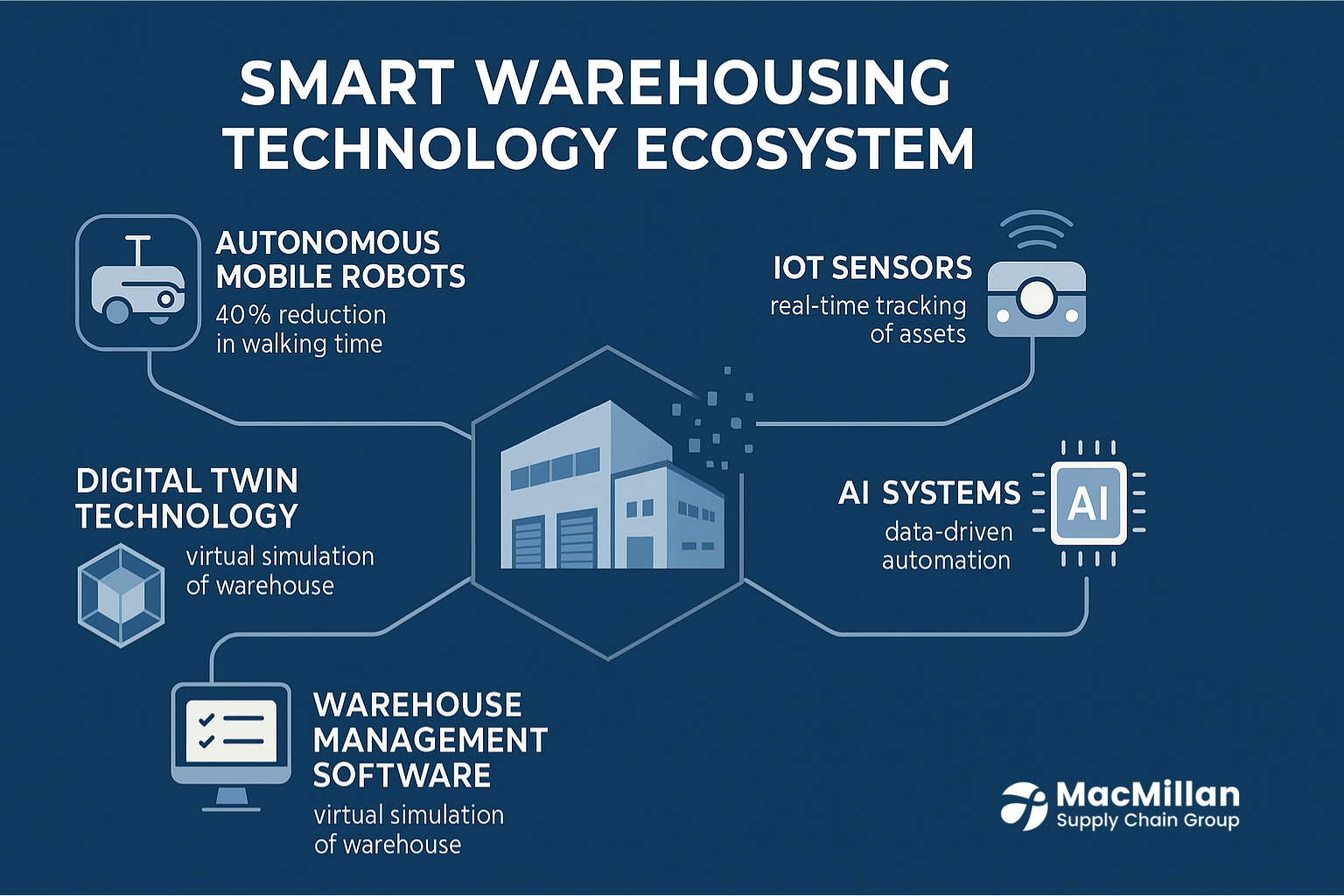
The foundation of any smart warehouse is built on several key technologies working in harmony. Let’s explore the innovations that are transforming traditional warehouses into intelligent operations centers:
Unlike their predecessors that required magnetic strips or predefined paths, today’s AMRs navigate warehouses independently using advanced sensors and mapping capabilities. These robots reduce walking time for employees by up to 40% and can operate 24/7 without breaks. At MacMillan, we’ve seen these robots increase picking efficiency by nearly 200% compared to traditional methods.
The Internet of Things (IoT) creates a network of connected devices throughout the warehouse. Temperature sensors monitor sensitive products, proximity detectors prevent collisions, and smart shelves track inventory in real-time. This connectivity provides unprecedented visibility into warehouse operations, allowing managers to make data-driven decisions instantly rather than waiting for end-of-day reports.
Artificial intelligence serves as the brain of smart warehousing, analyzing patterns and making predictions that humans simply couldn’t process. These systems optimize inventory levels, predict maintenance needs before equipment fails, and continuously improve picking routes. Predictive analytics in warehousing has reduced stockouts by up to 30% for our clients while simultaneously decreasing excess inventory.
Warehouse automation is changing every aspect of logistics operations, from receiving to shipping and everything in between. Here’s how automation is revolutionizing key warehouse processes:
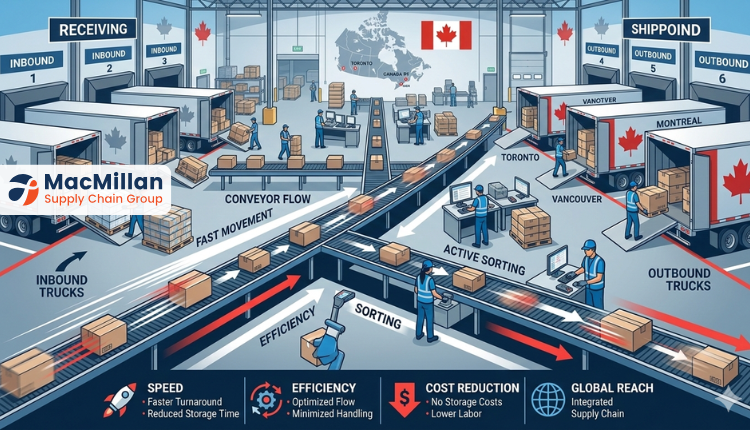
When shipments arrive, automated scanning systems immediately identify and log items without manual counting. Autonomous forklifts and conveyor systems then transport products to their optimal storage locations, determined by AI algorithms that consider factors like demand frequency and product relationships. This automation reduces receiving time by up to 60% while improving accuracy to nearly 99.9%.
Perhaps the most visible form of warehouse automation is robotic order fulfillment. Collaborative robots work alongside human pickers or independently retrieve items from storage. These systems can process orders up to three times faster than manual methods while reducing error rates significantly. For e-commerce fulfillment in CA, this speed and accuracy directly translates to customer satisfaction and repeat business.
Intelligent Sortation and Shipping
At the shipping stage, automated sortation systems direct packages to the correct loading dock based on destination, carrier, and priority. Weight-checking stations verify package accuracy, while automated labeling systems ensure proper documentation. This end-to-end automation creates a seamless flow from order receipt to delivery, minimizing touchpoints and maximizing efficiency.
While robots and automation provide the muscle of smart warehousing, data intelligence supplies the brainpower. Advanced warehouse management systems collect, analyze, and act on information in ways that transform operations:
Smart warehousing eliminates the dreaded “where is it?” question that plagues traditional operations. RFID tracking solutions and connected scanners provide instant location data for every item in the warehouse. This real-time inventory visibility reduces search time by up to 80% and virtually eliminates lost inventory, a common problem that costs warehouses millions annually.
One of the most exciting developments in smart warehousing is digital twin technology—virtual replicas of physical warehouses that update in real-time. These digital models allow managers to visualize operations, test changes in a risk-free environment, and identify bottlenecks before they impact performance. At MacMillan, we’ve implemented digital twins that have improved space utilization by 25% and throughput by 30%.
Using historical data, market trends, and even weather patterns, predictive analytics helps warehouses anticipate demand fluctuations with remarkable accuracy. This foresight allows for proactive inventory management, labor scheduling, and resource allocation. Our clients using these systems have reduced carrying costs by 15-20% while improving order fulfillment rates.
Canada’s unique geography, climate, and market conditions have driven specific innovations in smart warehousing technology:
Smart warehousing in Canada must account for extreme temperature variations that can affect both equipment and inventory. IoT-enabled climate control systems maintain optimal conditions while minimizing energy usage. Cold-chain monitoring for pharmaceuticals and food products has become increasingly sophisticated, with sensors that track temperature variations down to 0.1°C and automatically alert managers to potential issues.
With approximately 75% of Canadian exports going to the United States, smart warehousing systems in Canada often focus on seamless cross-border integration. Advanced tracking and documentation systems ensure compliance with customs requirements while minimizing delays. These systems have reduced border-related delays by up to 40% for businesses implementing smart logistics solutions.
Canadian warehousing trends show increasing emphasis on sustainability. Smart warehouses reduce environmental impact through optimized routing (reducing fuel consumption), energy-efficient lighting controlled by motion sensors, and waste reduction through precise inventory management. Green logistics strategy isn’t just environmentally responsible—it delivers measurable cost savings and appeals to increasingly eco-conscious consumers and business partners.
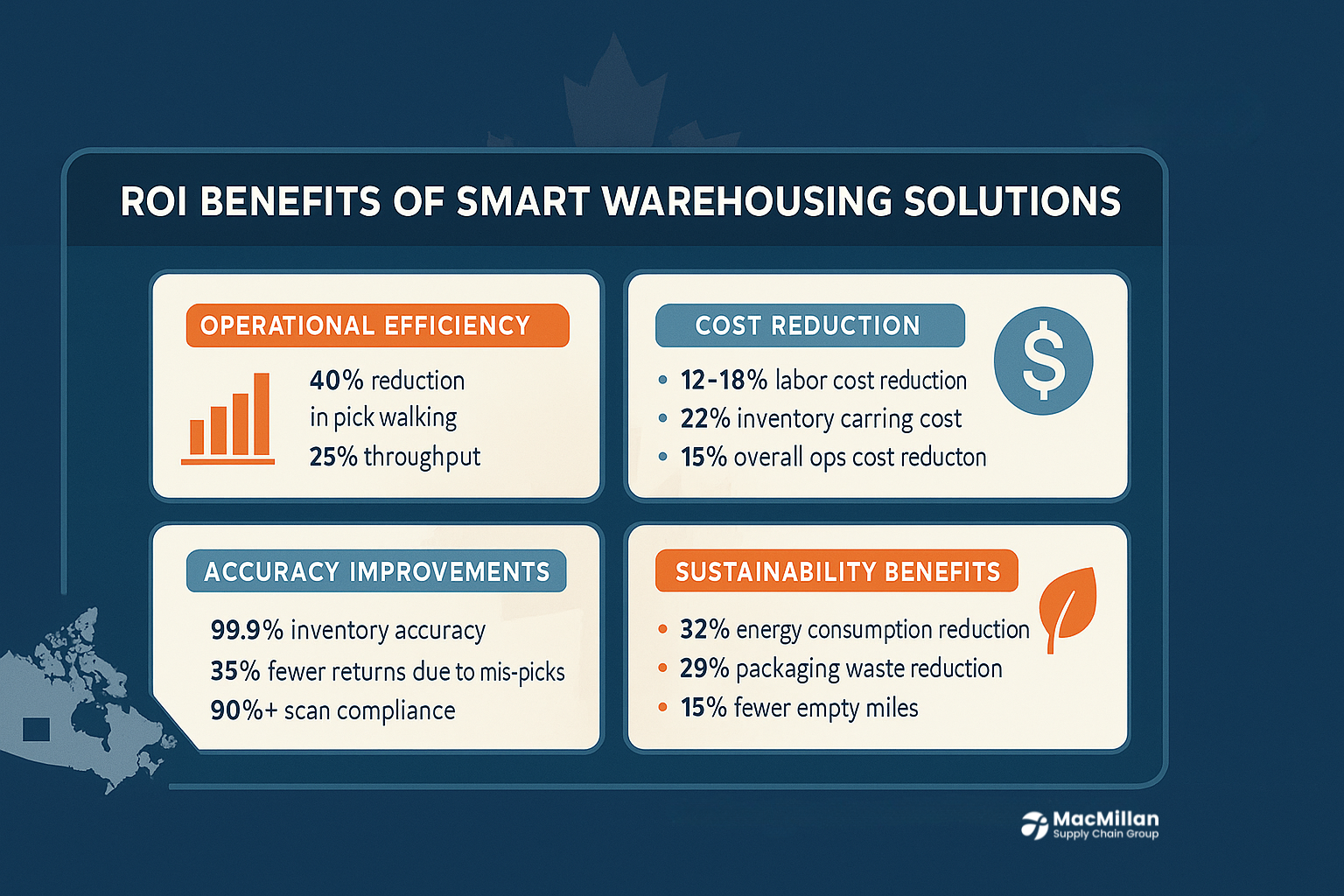
While the benefits of smart warehousing are clear, implementation isn’t without challenges:
The upfront costs of automation equipment, software systems, and facility modifications can be substantial. Many businesses struggle to justify these expenses despite the long-term ROI. Additionally, ongoing maintenance and upgrade costs must be factored into the total investment calculation.
Most warehouses don’t have the luxury of building from scratch. Integrating new technologies with existing systems often creates compatibility issues that require custom solutions. Data migration from older systems can be particularly challenging and time-consuming.
Smart warehousing changes job requirements and workflows, sometimes creating resistance among employees. Comprehensive training programs are essential but add to implementation timelines and costs. Finding workers with the right technical skills to operate and maintain advanced systems presents another challenge.
As warehouses become more connected, they also become more vulnerable to cyber threats. Cybersecurity for smart warehouses must address potential vulnerabilities in networked equipment, data storage systems, and remote access points. A single breach could potentially shut down operations or compromise sensitive customer information.
At MacMillan Supply Chain Group, we’ve developed comprehensive strategies to overcome the challenges of smart warehousing implementation while maximizing the benefits for our clients:
Rather than attempting a complete warehouse transformation overnight, we recommend a strategic, phased approach. This method allows businesses to:
For example, we helped a Toronto-based retailer implement RFID tracking solutions in a single department before expanding to their entire operation. This approach delivered a 35% efficiency improvement in the test area, providing proof of concept and building momentum for the broader implementation.
Our technology specialists develop tailored integration plans that bridge the gap between legacy systems and new technologies. We prioritize:
For a Montreal distribution center, we created custom interfaces between their existing ERP system and new robotic picking technology, preserving their investment in core business systems while adding advanced capabilities.
We recognize that technology is only as effective as the people who use it. Our implementation plans always include:
When implementing collaborative robotics at a Vancouver facility, we created a “Technology Champion” program that identified tech-savvy employees and provided advanced training. These champions then helped train their colleagues, accelerating adoption and reducing resistance.
Our approach to cybersecurity for smart warehouses includes:
This multi-layered approach has helped our clients maintain operational integrity even as their technology footprint expands.
We prioritize technologies that deliver both operational and environmental benefits:
For a Calgary client, our green logistics strategy reduced energy consumption by 32% while simultaneously improving throughput by 45%—proving that sustainability and efficiency can go hand-in-hand.
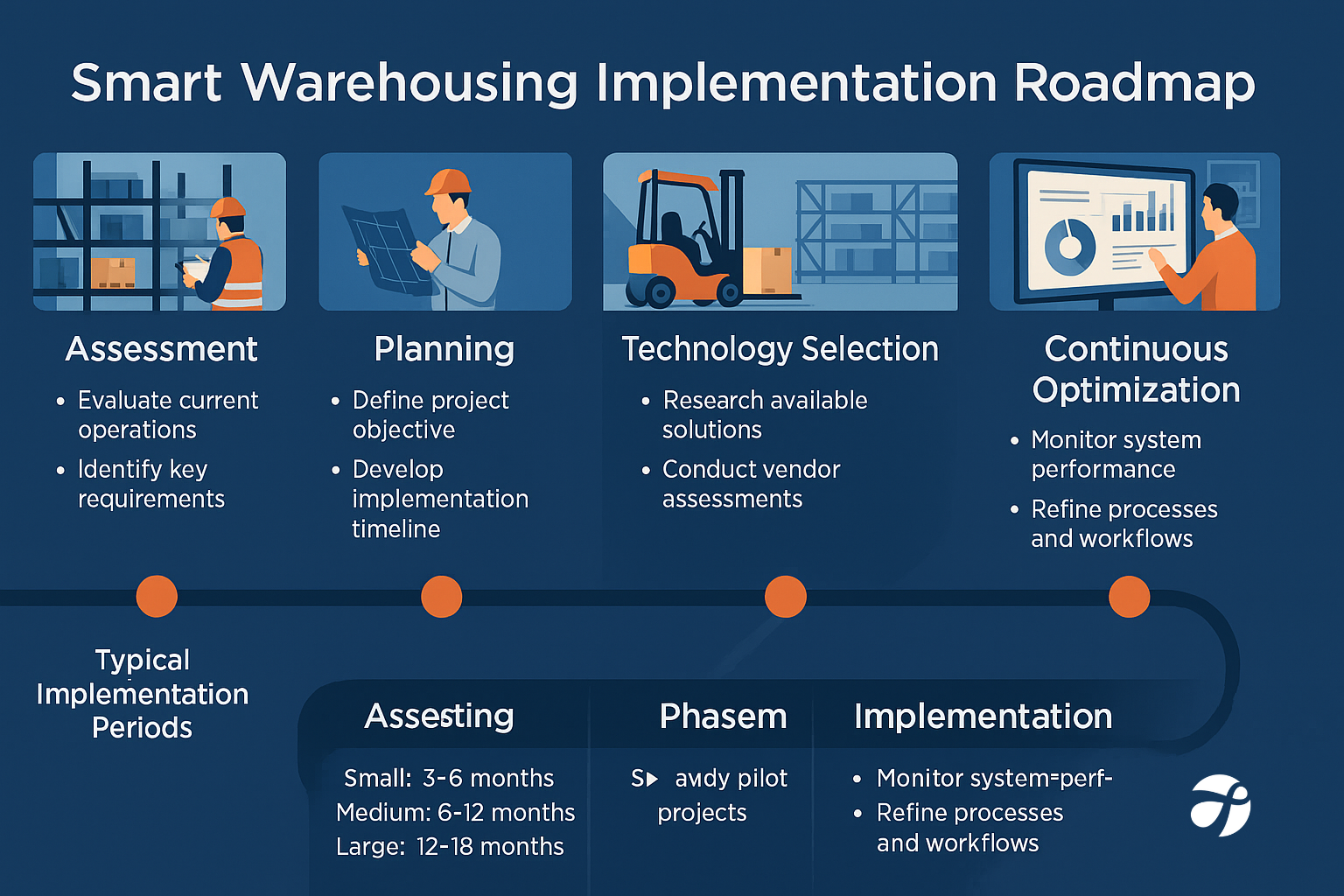
Ready to transform your warehouse operations with intelligent technology? Here’s how to begin your smart warehousing journey:
Start by evaluating your current operations to identify opportunities for improvement. Which processes consume the most time? Where do errors typically occur? What are your biggest operational challenges? This assessment will help prioritize technology investments for maximum impact.
Document your current workflows, systems, and performance metrics to establish a baseline for measuring improvement. Consider bringing in experts to conduct a comprehensive warehouse audit—they often spot opportunities that internal teams might miss.
Define specific, measurable goals for your smart warehousing initiative. Rather than simply “implementing technology,” focus on outcomes like “reduce picking errors by 50%” or “decrease order fulfillment time by 30%.” These concrete objectives will guide technology selection and help measure ROI.
Smart warehousing requires a blend of logistics knowledge and technical expertise. Consider whether you need to hire new talent, train existing staff, or partner with external specialists. The right implementation team can make the difference between success and costly setbacks.
Don’t navigate the complex world of smart warehousing alone. MacMillan Supply Chain Group offers comprehensive support for businesses at every stage of technological transformation:
Our team brings decades of experience in Canadian logistics innovations and intelligent warehousing solutions. We understand the unique challenges of implementing smart warehousing technology in the Canadian market and have developed proven strategies to overcome them.
Contact MacMillan Supply Chain Group today to schedule a consultation with our smart warehousing specialists. Let us help you transform your logistics operations for greater efficiency, accuracy, and competitive advantage in today’s demanding marketplace.